
Deputy CM Arun Sao outlines roadmap for urban development and housing reforms
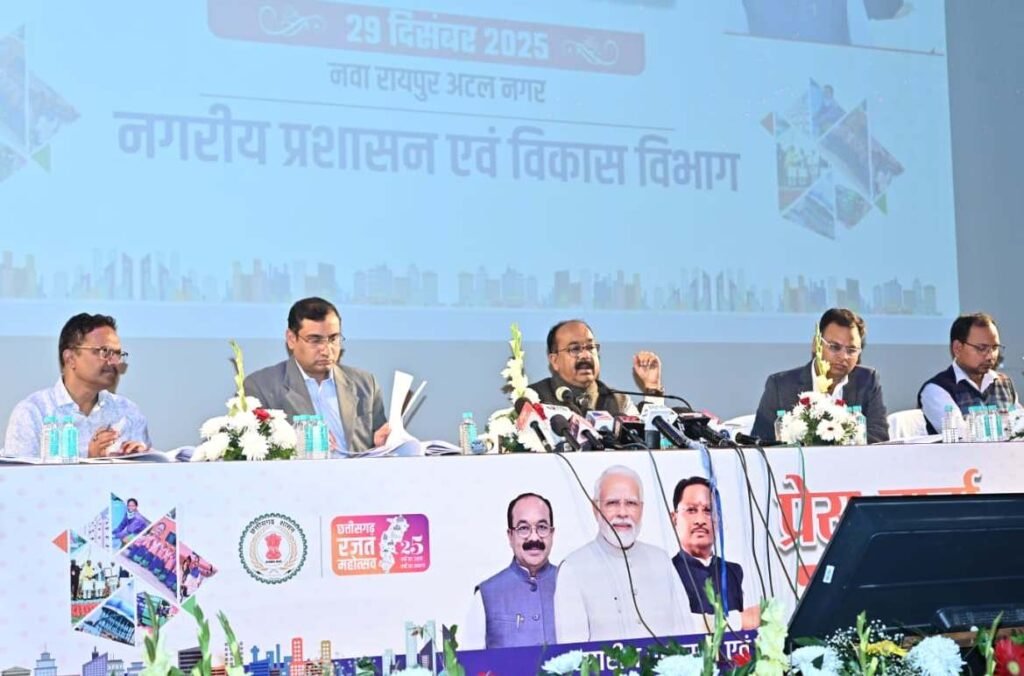
Raipur, Deputy Chief Minister Arun Sao on Monday detailed a comprehensive roadmap for urban transformation, highlighting key achievements in housing, sanitation, and infrastructure. During a press conference, Sao emphasised that the state is focusing on planned expansion and inclusive growth to support Chhattisgarh’s rising urban population, estimated at 78.10 lakh in 2025.
The Deputy Chief Minister stated that under the Pradhan Mantri Awas Yojana (Urban) 2.0, the state has set a target of 1.32 lakh houses, with over 24,000 units already sanctioned. He noted that nearly 59,000 houses were completed in the last two years, reinforcing the government’s commitment to providing permanent housing for all eligible homeless urban families.
Highlighting achievements in the Swachh Survekshan 2024–25, Sao noted that Chhattisgarh has once again emerged as a national leader in cleanliness. Bilha Nagar Panchayat secured the first rank nationally among small cities, while Bilaspur ranked second in its category. The state capital, Raipur, was recognised as a ‘Promising Clean City’. To support these efforts, over 9,000 women sanitation workers are currently engaged in door-to-door waste collection.
On urban infrastructure, the Deputy Chief Minister announced that under AMRUT 2.0, projects worth ₹1,100 crore have been approved for water supply. The mission targets 1.38 lakh new tap connections by December 2027. Additionally, sewage treatment plants with a capacity of 333 MLD are being developed in major cities including Bhilai, Durg, and Korba. To modernise public transport, 240 electric buses have been approved for Raipur, Durg-Bhilai, Bilaspur, and Korba.
Sao also touched upon social welfare reforms, noting that over 93,000 street vendors have received loans totalling ₹198.56 crore under the PM SVANidhi scheme. He further highlighted the expansion of the Chief Minister Slum Health Scheme, which provides free medical consultations and diagnostics to the urban poor through mobile medical units.