
Chhattisgarh presents ₹1.72 lakh crore budget, targets developed state status by 2047
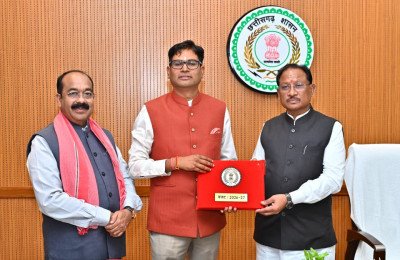
Raipur, Feb 24: State Finance Minister OP Choudhary on Tuesday tabled a ₹1.72 lakh crore budget for the 2026–27 fiscal in the Chhattisgarh Legislative Assembly, marking the third such exercise by the Vishnu Deo Sai-led BJP government. Centred on the vision of “Chhattisgarh Anjore-2047,” the budget seeks to lay a comprehensive roadmap to transform the state into a developed entity by the centenary of India’s independence.
Delivering a marathon speech lasting one hour and 48 minutes, which was frequently interrupted by applause from the treasury benches, Choudhary traced the state’s economic journey. He pointed out that the state’s budget has expanded 35 times since the formation of Chhattisgarh in 2000, when the total outlay was a mere ₹4,944 crore. This growth, he argued, reflects a sustained trajectory of economic expansion balanced with social justice and regional equity.
Fiscal health and growth targets
The budget projects the Gross State Domestic Product (GSDP) at ₹7,09,553 crore, representing a robust 12.4 per cent growth over the previous year’s estimate of ₹6,31,290 crore. Total receipts and expenditure for the fiscal have been balanced at ₹1.72 lakh crore, with revenue expenditure pegged at ₹1.45 lakh crore.
On the fiscal front, the government has managed to keep the fiscal deficit at ₹20,400 crore, or 2.87 per cent of the GSDP, which remains well within the prescribed prudential limits. However, the Finance Minister has projected a revenue deficit of ₹2,000 crore for the upcoming financial year.
Focus on tribal heartlands and education
A standout feature of this year’s budget is the heavy investment in the Bastar and Surguja regions. The government has proposed the development of two “Education Cities” in the sensitive areas of Abujhmad and Jagargunda in Bastar, with an initial allocation of ₹100 crore. These cities are designed to serve as modern educational hubs for tribal youth, bridging the developmental gap in remote districts.
Furthermore, the state has earmarked ₹100 crore each for the promotion of food, agriculture, and allied industries specifically in Bastar and Surguja. To preserve the indigenous identity of these regions, the budget proposes the “Janjatiya Sur-Gudi” initiative to promote and document tribal heritage.
Sectoral allocations and infrastructure
The Sai government continues its focus on the rural economy and education. The School Education department received the highest sectoral allocation of ₹22,360 crore, followed by Panchayat and Rural Development at ₹16,560 crore. Agriculture has been allocated ₹13,507 crore, while the Food and Civil Supplies department will receive ₹12,820 crore.
Infrastructure also remains a top priority. The budget provides ₹4,000 crore each for the Viksit Bharat@Gram Gramodaya Abhiyan and the PMAY-Gramin. For urban housing, ₹825 crore has been set aside for PMAY-Urban. Additionally, the government has announced ₹250 crore for 23 new industrial parks and ₹200 crore for a Land Bank Development Scheme to spur industrial growth.
New missions and welfare schemes
Choudhary unveiled five major missions aimed at future-proofing the state’s economy: the Mukhyamantri AI Mission, Sports Excellence Mission, Tourism Development Mission, Infrastructure Mission, and the Startup and NIPUN Mission. Each mission carries a minimum annual commitment of ₹100 crore over the next five years.
For social welfare, the flagship Krishak Unnati Yojana has been granted ₹10,000 crore, while the Mahtari Vandan Yojana receives ₹8,200 crore. Other notable allocations include ₹2,000 crore for the National Health Mission and ₹1,500 crore for the Shaheed Veer Narayan Singh Ayushman Yojana.
The budget also introduces several new initiatives, including the Mukhyamantri Adarsh Shahar Samriddhi Yojana for urban development and the CG ACE programme to provide support for competitive examinations. With an emphasis on everything from “Lakhpati Didi” tours to drone-based road monitoring under the Mukhyamantri Drutgami Sadak Sampark Yojana, the 2026–27 budget outlines a tech-driven and inclusive growth strategy for Chhattisgarh.