
CM Vishnu Deo Sai hails Koriya’s water conservation model in PM’s Mann Ki Baat
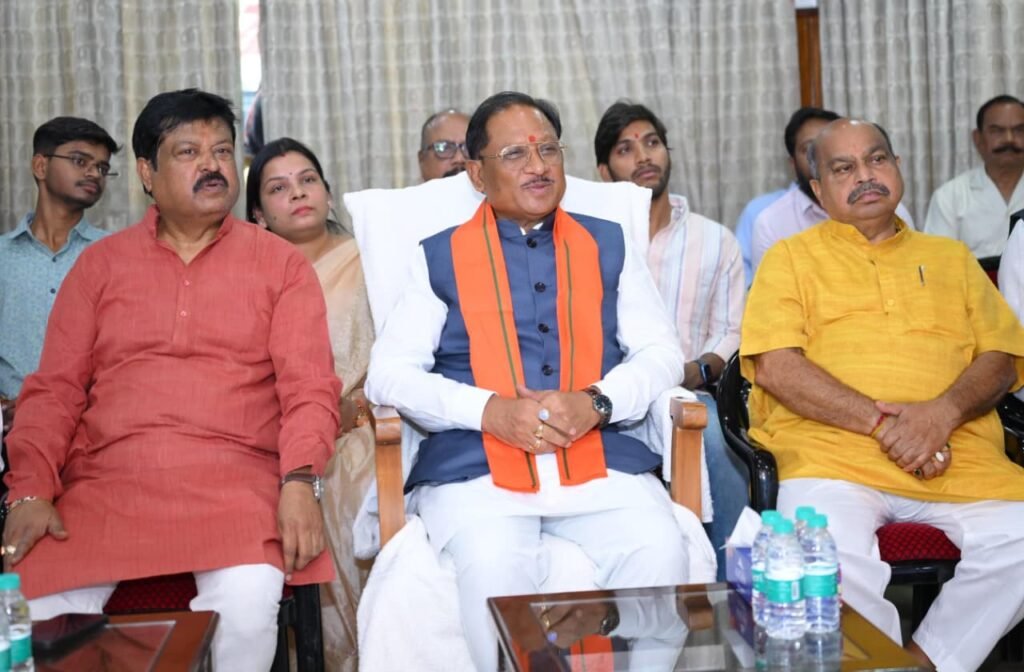
Raipur, March 29: Chief Minister Vishnu Deo Sai listened to the 132nd episode of Prime Minister Narendra Modi’s monthly radio programme Mann Ki Baat at his official residence on Sunday, describing it as a source of inspiration that brings grassroots innovations to the national stage.
The Chief Minister said the Prime Minister’s appreciation of water conservation efforts in Koriya district is a matter of pride for Chhattisgarh. Highlighting the “Aawa Pani Jhonki” model, he noted how farmers have constructed recharge ponds and soak pits in their fields. This initiative has led to a noticeable improvement in groundwater levels, creating a successful model for replication across the state.
He stated that water conservation has evolved into a mass movement under the leadership of Prime Minister Narendra Modi. The Chief Minister urged citizens to adopt conservation practices in their daily lives to ensure long-term sustainability, reiterating the state government’s commitment to expanding these efforts through active public participation.
The Chief Minister also referred to other themes highlighted in the programme, including self-reliance in fish production, the importance of fitness, reducing sugar consumption, and promoting sports. He said Chhattisgarh is taking planned initiatives to strengthen fisheries and encourage healthier lifestyles to boost the rural economy.
Addressing concerns regarding the situation in West Asia, the Chief Minister assured that India is fully prepared to handle any challenges through coordinated efforts between the Centre and states. He clarified that there is no shortage of petroleum products, cooking gas, or essential commodities in Chhattisgarh. He appealed to the public to avoid rumours and rely only on official information.
MLA Purandar Mishra, Chhattisgarh Civil Supplies Corporation Chairman Sanjay Srivastava, Media Advisor Krishna Das, and other dignitaries were present on the occasion.
A community-driven water conservation initiative from Chhattisgarh’s Koriya district has emerged as a national model, earning praise from Prime Minister Narendra Modi for its impact and scalability. Popularly known as the “Koriya Model,” the initiative has transformed water conservation into a mass movement rooted in public participation.
The campaign, titled “Aawa Pani Jhonki,” was implemented under the national ‘Catch the Rain’ initiative and the state government’s ‘Mor Gaon Mor Pani Maha Abhiyan’. It has evolved from a government scheme into a people-led effort that integrates scientific planning with grassroots engagement.
The Prime Minister highlighted the model during his radio programme Mann Ki Baat, describing it as an inspiring example of how collective participation can address water challenges. Union Jal Shakti Minister CR Patil also lauded the initiative, terming it a replicable blueprint for other states. Chief Minister Vishnu Deo Sai stated that the Koriya Model reflects the state’s commitment to empowering communities to take ownership of water security.
Despite an average annual rainfall of around 1,370 mm, Koriya district previously struggled with rapid water runoff due to its hilly terrain. To address this, the administration introduced the “5 per cent Model” under the Jal Sanchay Jan Bhagidari Abhiyan, encouraging farmers to voluntarily allocate five per cent of their land for constructing small water-harvesting structures.
Additional interventions included the construction of soak pits and conservation structures under the Mahatma Gandhi National Rural Employment Guarantee Act (MGNREGA). Women played a key role as “Neer Nayikas,” while youth contributed as “Jal Doots,” ensuring strong community ownership through Gram Sabhas.
As a result of these combined efforts, approximately 28 lakh cubic metres of water has been recharged into the groundwater system. A report by the Central Ground Water Board (CGWB) recorded a significant rise of 5.41 metres in groundwater levels in 2025. Currently, more than 20,600 water conservation works have been completed or are ongoing in the district, including over 17,000 community-led initiatives.
Koriya District Collector Chandan Sanjay Tripathi stated that the success lies in public participation, noting that when communities take ownership, the outcomes are both sustainable and far-reaching. The Koriya Model now stands as a compelling example of how coordinated efforts between the administration and the public can transform water conservation into a scalable national movement.