
Prime Minister Narendra Modi chairs DGP/IGP Conference
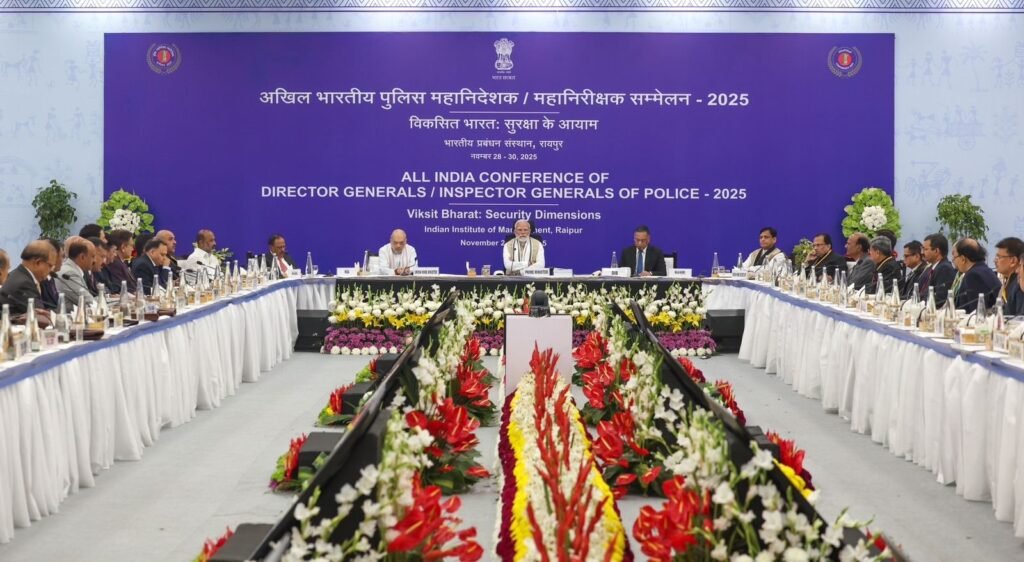
Raipur, Prime Minister Narendra Modi on Saturday chaired the 60th All-India Conference of Directors General of Police (DGP) and Inspectors General of Police (IGP) at the Indian Institute of Management (IIM) campus in Naya Raipur, Chhattisgarh. The conference is serving as a high-level forum for top security officials from across the country to deliberate on India’s internal security challenges and future roadmap.
The Prime Minister, who joined the three-day deliberations on the second day, remarked that the conference witnessed extensive discussions on different aspects of India’s security system. He underscored that the forum is a vital platform to share best practices and innovations in the field of national security, an official statement said.
In his address, Prime Minister Modi commended the dedication, courage, and tireless service of security forces operating under challenging circumstances. He emphasised that national security must remain a collective priority and urged police officers to adopt modern technology, strengthen digital preparedness, and rely on data-driven decision-making to tackle contemporary threats.
In a post on X, PM Modi said, “The first day of the DGP/IGP Conference in Raipur witnessed extensive deliberations on different aspects of India’s security system. This is a great forum to share best practices and innovations in this field.”
Earlier, Union Home Minister Amit Shah inaugurated the conference on Friday, hailing it as a transformative “portal of solutions” to India’s internal security challenges.
In his inaugural address, Home Minister Shah highlighted the significant strides made by police forces over the past 11 years in combating radicalisation, extremism, insurgency, and narcotics trafficking. He asserted that under PM Modi’s leadership, the conference has evolved into a key platform for strategising and policymaking for a secure nation.
Addressing a gathering of over 300 top police officers, he announced that the country will be completely free from the menace of Naxalism before the next DGP-IGP conference. He pointed out that actionable steps, including the construction of 586 fortified police stations in Maoist-affected areas, have resulted in the number of Naxal-affected districts dropping from 126 in 2014 to just 11 today.
Shah reiterated the government’s approach of providing “permanent solutions” to longstanding security hotspots—Naxalism, Northeast insurgency, and Jammu and Kashmir unrest—to transform them into integrated growth engines.
He stressed the importance of digital tools and technological innovation in crime prevention and timely detection. He called for a “360-degree attack” on narcotics and organised crime, demanding that state police forces work in coordination with the Narcotics Control Bureau (NCB) to ensure drug traffickers are not afforded “even an inch of space” in the country, aligning with the national goal of a drug-free India.
DGPs and IGPs presented models of successful policing initiatives, crime control methods, and technological reforms implemented in their respective states. Detailed discussions were held on topics such as real-time surveillance systems, the use of drone technology, predictive policing through data analytics, and effective social media monitoring. Officials underscored that continuous technological upgrades and innovation can significantly improve service delivery and make policing more citizen-centric.
Challenges such as terrorism, cybercrime, human trafficking, narcotics control, and large crowd management were also evaluated. The conference aims to strengthen collaboration among police leadership from various states and Union Territories by enabling them to learn from each other and build cohesive strategies for emerging security challenges.
The deliberations, spread over November 28–30, will focus on precision intelligence, clear objectives, and inter-agency synergy to counter new-age threats like cybercrime, Left-Wing Extremism (LWE), border incursions, and organised crime.
The conference, which will conclude on Sunday, is also being attended by National Security Advisor Ajit Doval, Ministers of State for Home Nityanand Rai and Bandi Sanjay Kumar, Intelligence Bureau Director Tapan Kumar Deka, and Home Secretary Govind Mohan, along with DGPs and IGPs from all states and Union Territories.