
Chintan Shivir 3.0 charts roadmap for Viksit Chhattisgarh, says CM Vishnu Deo Sai
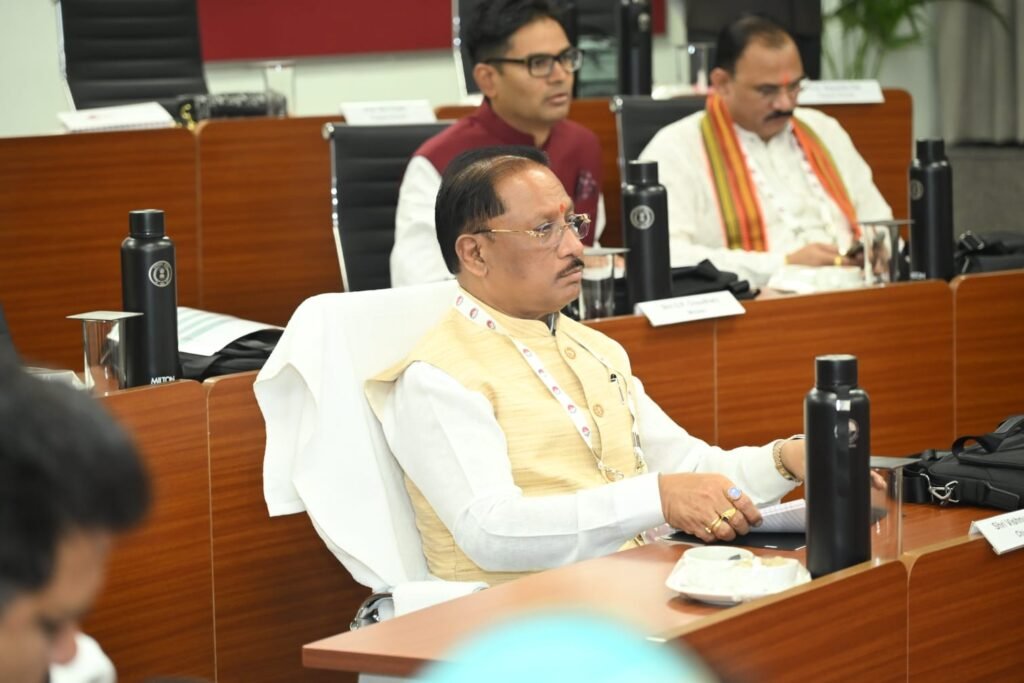
Raipur, July 23: Chhattisgarh Chief Minister Vishnu Deo Sai on Sunday announced that the state government will soon translate the recommendations of Chintan Shivir 3.0 into policy initiatives to build a modern, transparent, and technology-driven administration. Speaking at the valedictory session of the two-day conclave jointly organised by the Department of Good Governance and Convergence and IIM Raipur, the Chief Minister said the forum has evolved into an effective platform for driving structural governance reforms to achieve the vision of ‘Viksit Chhattisgarh’.
Highlighting the structural reforms stemming from previous editions, Chief Minister Sai noted that the state has successfully implemented the e-Office system for faster file disposal. The administration has also launched the CM Helpline 1076 for grievance redressal alongside the Sewa Setu portal, which currently provides over 520 online services across 36 departments to simplify public service delivery.
The conclave featured extensive deliberations on transforming the state’s tourism landscape. Senior IAS officer and tourism policy expert Suman Billa stated that Chhattisgarh possesses the potential to emerge as India’s leading high-value, low-impact tourism destination by leveraging nature, tribal, and cultural tourism. He called for robust infrastructure development, community participation, and stronger Centre-State coordination to position the Bastar region prominently on the international tourism map, suggesting that the state’s Industrial Policy be utilised to catalyse tourism investments.
Advocating a decentralised economic framework, Lok Sabha MP Shashank Mani Tripathi proposed a district-centric growth model, describing the district as the “fulcrum of growth”. He urged the formulation of district-specific development plans and District GDP-based planning to boost entrepreneurship, local innovation, and agricultural transformation across Tier-2 and Tier-3 regions through concepts like ‘Amrit Prayas’.
The two-day event also focused significantly on technological integration and agricultural modernization. NITI Aayog member Prof. Abhay Karandikar outlined strategies for deploying artificial intelligence, digital public infrastructure, 5G, drones, and blockchain for data-driven governance. Concurrently, agricultural experts Dr Ramesh Chand and T. Vijay Kumar led sessions on promoting natural farming, climate-resilient agriculture, and crop diversification to enhance farmers’ incomes and strengthen the rural economy.
Indian Council for Cultural Relations (ICCR) President Dr Vinay Sahasrabuddhe and spiritual thinker Gaur Gopal Das also addressed the state leadership on value-based governance and ethical administrative practices during the concluding sessions.